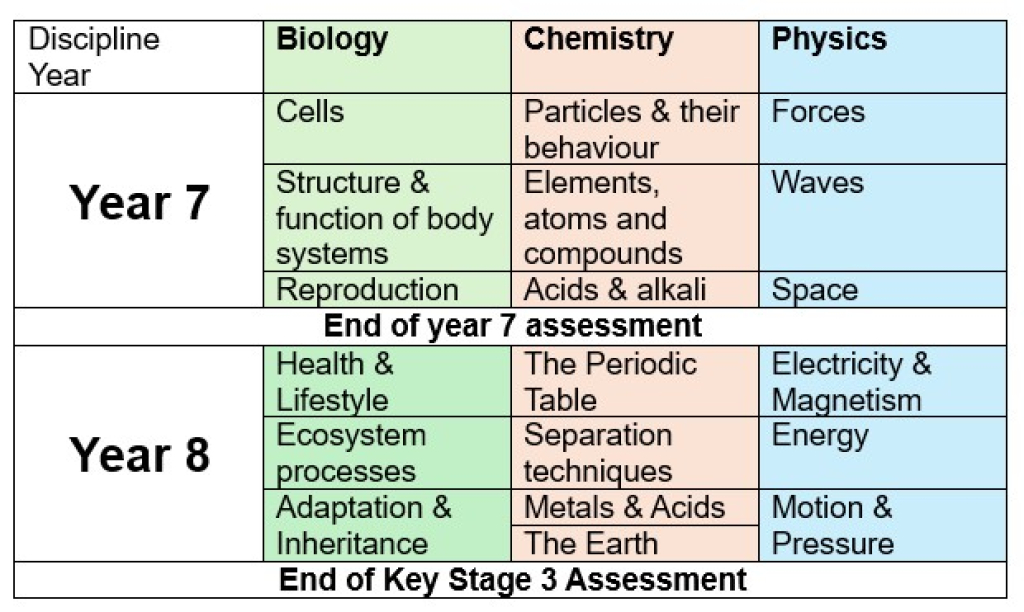
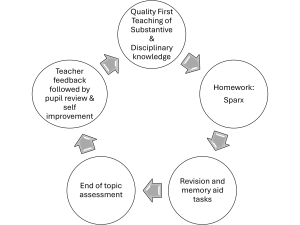
The science curriculum, both at key stage 3 and 4, is packed with SMSC strands that enables pupils to understand the content being taught but also the impact the science can have on themselves and others around them.
Spiritual development: In Science…. this involves the search for meaning and purpose in natural and physical phenomena. It is the wonder about what is special about life, an awe at the scale of living things from the smallest micro-organism to the largest tree and the interdependence of all living things and materials of the Earth. It concerns the emotional drive to know more and to wonder about the world and aesthetically appreciate its wonders including for example the enormity of space and the beauty of natural objects or phenomenon.
Topics included are:
- Reproduction, pregnancy and contraception.
- Health and disease
- Genetic engineering
- Nervous and hormonal response
- Drugs – medicinal and illegal
- Evolution
- Earth’s structure
- Vaccinations
- Energy resources
Moral development: Our understanding of Science has allowed us to develop technology we couldn’t have imagined 50 years ago. Now however, we must start deciding if we should we do all the scientific activities we are able to or morally should we decide not to. This can be as simple as should we test medicines for humans that could save lives on animals causing them cruelty? It could be as complex as should we allow somatic or germ line cell therapy. Moral development is a vital part of any scientist’s development. Students will need to develop a good understanding of it to firstly pass exams which always comprise of ethical questions but more importantly to become a good rounded scientist.
Topics that promote moral development include:
- Fossil fuels and renewable fuels
- Diet and exercise
- Malnutrition
- Combustion and global warming
- Photosynthesis
- Food chains and webs
- Drug development
- Animal testing
- Vaccinations
- Nuclear power
Social development: In Science…this involves group practical work which provides opportunities for pupils to develop team working skills and to take responsibility. Pupils must take responsibility for their own and other people’s safety when undertaking practical work. Science has a major effect on the quality of our lives. Pupils are encouraged to consider the benefits and drawbacks of scientific and technological developments and the social responsibility involved.
Activities that promote social development:
- Working safely in science – adhering to laboratory rules
- Team work and collaboration
- Debating
- Presentations
- Listening and responding to others
- Managing scientific conflict
- Linking science to different beliefs and cultures
Cultural development: Scientific development comes from all across the world, from people of all backgrounds and cultures. It is also important to understand how the different cultures around the world can have different impacts on the planet and what impact more economically developed countries have on poorer areas. This will also be vital into the future as we need to monitor the impact of quickly developing cultures around the world on our environment.
Examples of topics that promote cultural development:
- Periodic table
- Development of the atom
- Antibiotic functions
- Vaccinations
- Micro-organisms and disease
- Radioactivity
- Solar system